
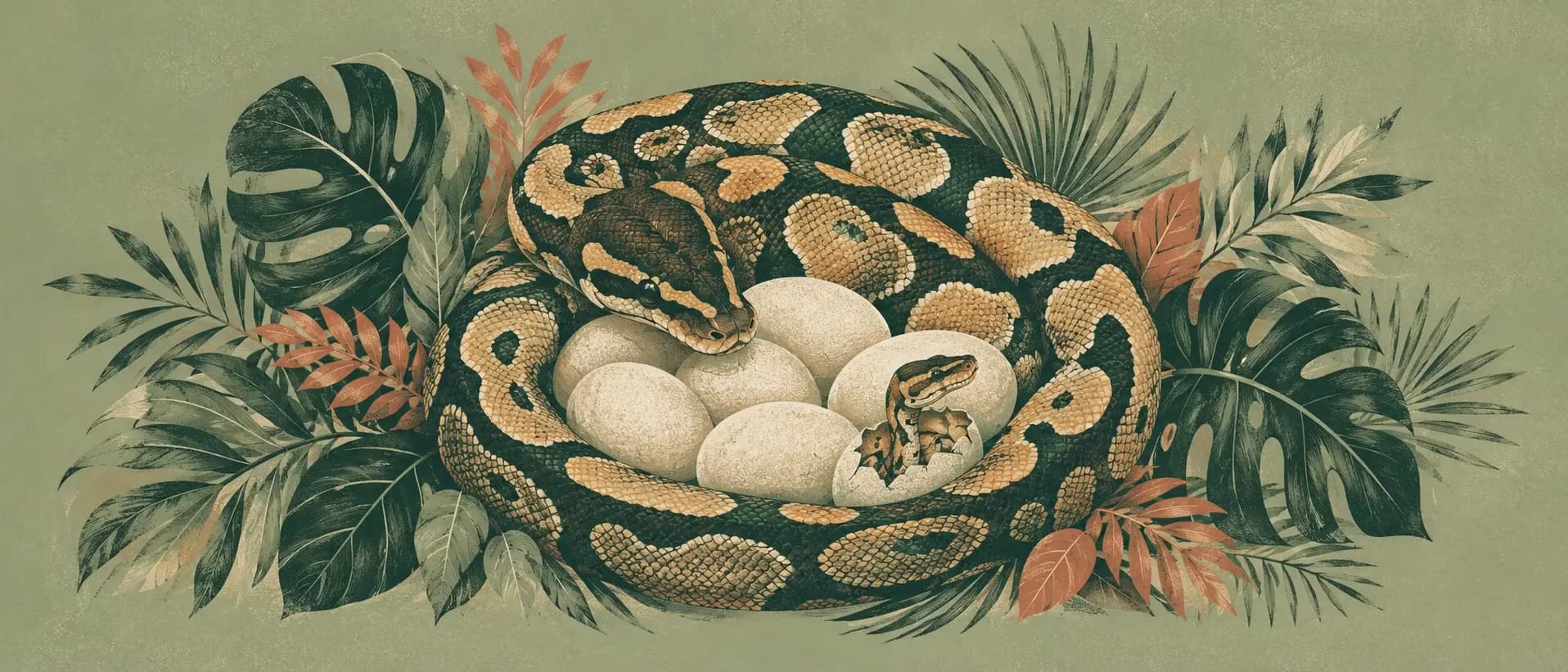
Genetic Traits in Reptiles
Abstract
This article provides an overview of genetic traits in reptiles, examining how DNA variations influence color, pattern, and physiology. It covers the cellular mechanisms underlying pigmentation, patterns of inheritance including dominant, recessive, and polygenic traits, the role of mutation in generating novel variation, and the significance of genetic diversity for captive population management.
1. What Are Genetic Traits?
Genetic traits are biological characteristics shaped by variations in DNA. In reptiles, traits can influence color, pattern, body form, physiology, and a wide range of less visible characteristics that affect how an animal develops and functions over time. Some traits are immediately apparent (the phenotype), while others remain hidden in the genetic code (the genotype) unless they are expressed under specific genetic combinations or identified through analysis.
 GENOTYPE (DNA carried)PHENOTYPE (what shows)
2. How Traits Arise: Chromatophores
Traits arise from the way genes interact within an organism. In reptiles, most visible variation is linked to pigment-producing cells in the skin called chromatophores. Melanophores produce dark pigments, iridophores create reflective and iridescent effects via structural light scattering, and xanthophores and erythrophores generate yellow, orange, and red tones. The distribution, density, and layering of these cell types are guided by genetic pathways. Small changes in these pathways can result in pronounced shifts in color or pattern, which is why a single genetic variant may dramatically alter an animal's appearance.
 Melanophore (dark)Iridophore (reflective)Xanthophore (yellow/red)
3. Inheritance and Expression
Not all traits behave the same way across generations. Some follow relatively simple inheritance patterns. A dominant trait may be expressed with only one copy of a variant, while a recessive trait typically requires the same variant to be inherited from both parents before it becomes visible. Many reptile variants also exhibit incomplete dominance, where a single copy of a gene produces one look, but two copies produce a distinct "Super" form. Albinism is a well-known example of a recessive trait, resulting from mutations that affect pigment production and only appearing when both parental lines carry the same variant. Other traits are polygenic, influenced by multiple genes acting together. These traits may emerge gradually over several generations and can be difficult to predict from appearance alone.
Many genetic traits do not express visibly in every generation. An animal may carry genetic variants without showing outward signs, typically referred to as being heterozygous (a "Het" or carrier) for a trait. These hidden genotypes can remain unobserved for years and may only surface when combined with compatible variants in future pairings. This is a normal aspect of inheritance and reflects the complexity of genetic systems rather than unpredictability or error. Genetics provides a way to understand why traits sometimes appear unexpectedly and why others remain absent despite repeated observation.
 ONE COPY vs TWOone copy: carrier, looks normaltwo copies: trait shows
4. Mutation and Variation
Beyond inherited variation, mutation plays a central role in introducing new traits. Genetic changes occur naturally and can affect pigment production, pattern distribution, scale structure, or other biological features. Advances in genetic research have identified specific genes that influence complex traits, such as those regulating iridescent pigmentation in reptiles, helping to explain how striking natural coloration evolved and why certain traits persist across lineages separated by long spans of time.
5. Genetic Diversity
Genetic diversity is the foundation of population health. In both wild and captive reptiles, diversity reflects the range of genetic variants present across individuals. Populations descending from a limited number of founders, a phenomenon known as the “founder effect”, may gradually lose this variation, making certain traits more common while others disappear. Over time, reduced diversity can lead to inbreeding depression, increasing the likelihood that unintended conditions like kinked spines, "bug eyes," or neurological "wobbles" accompany selected visual traits. Studies across multiple reptile species link reduced diversity to lower fertility and diminished resilience under environmental stress.
Traits are not limited to appearance. Genetic variation also influences growth patterns, immune function, reproductive potential, and overall vitality. While these characteristics may not be visually distinct, they shape how animals thrive and respond to their environment. By understanding how traits arise, persist, and move across generations, keepers and breeders gain clearer context for the patterns they observe over time. Genetics does not replace the intuition of a seasoned keeper, but it provides the biological framework needed to understand traits not as isolated features, but as part of a continuous history connecting animals, lineages, and generations.
 FOUNDER EFFECTdiverse foundersnarrowed diversity over generations
6. Summary
- Genetic traits are shaped by DNA variations that influence color, pattern, physiology, and less visible characteristics.
- Chromatophores (melanophores, iridophores, xanthophores, and erythrophores) are the pigment cells that produce reptile coloration.
- Inheritance follows dominant, recessive, incomplete dominant, and polygenic patterns; heterozygous carriers can pass traits without expressing them.
- Reduced genetic diversity increases the risk of inbreeding depression and unintended conditions in captive populations.
- Genetics provides the biological framework to understand traits as part of a continuous history connecting animals, lineages, and generations.